NoteKub website
notekub.dev is the public site — the product pages, the pricing page, and the manual you are reading. The workspace itself is a different origin: app.notekub.dev. Nothing you type here is your data, because there is no account on this side of the line.
Two languages, two real paths
English lives at the root and Thai under /th/ — so the pricing page is /pricing/ and /th/pricing/, and this guide is /manual/notekub-website/ and /th/manual/notekub-website/.
They are real pages, not a runtime switch: the site is a static export, so each language is built and served as its own HTML. That is also why the switcher in the header knows which page to send you to — it maps the page you are on to its twin, rather than dropping you at the home page.
- 1.Use the language control in the header to switch.
- 2.The label is written in the language it switches to — English, or ไทย.
- 3.The URL changes to match, so a link you copy carries the language with it.

What is on the site
Product describes what NoteKub does. Pricing says what it costs. Manual is these guides. Open app takes you to the workspace.
The header carries all four, beside the language link and a light / dark theme switch; on a narrow screen they collapse into a menu behind a button rather than disappearing.
The manual has a header of its own: a search box, the language link, the theme switch and Open app. The NoteKub logo at the top of its left rail goes back to the home page.
- 1.Read Product for an overview.
- 2.Read Pricing before you commit to anything.
- 3.Come back to Manual whenever you are stuck.
Finding your way around the manual
/manual/ opens straight on the first guide, Getting started and workspaces. There is no separate index page: the rail on the left is the index.
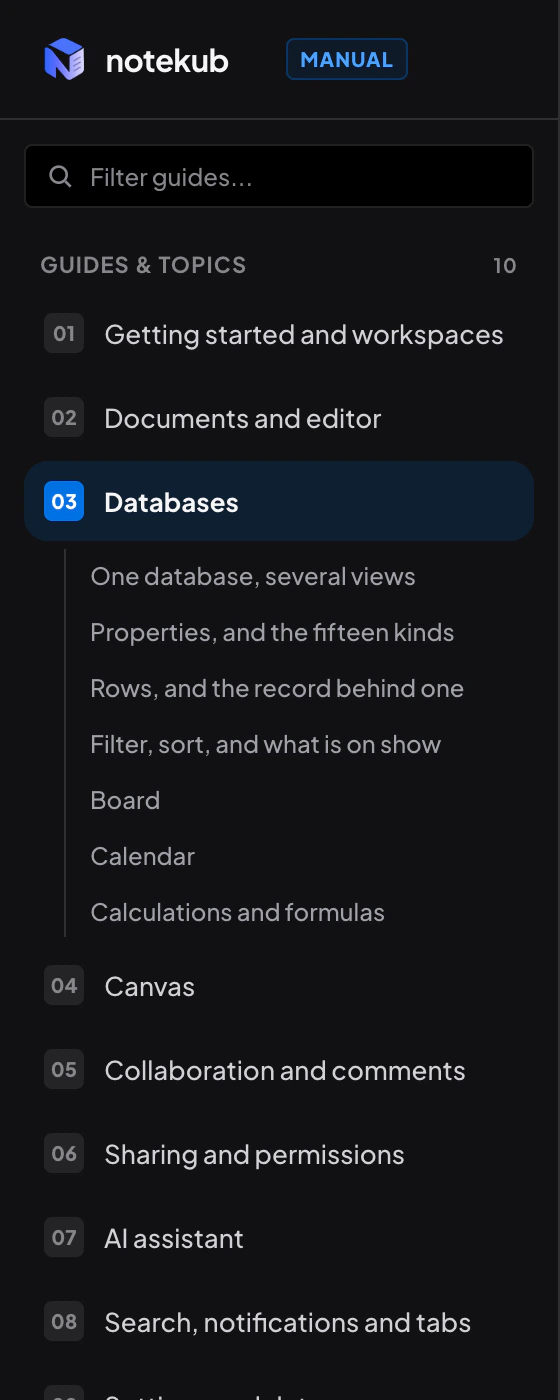
The rail lists all ten guides by number. The guide you are reading is highlighted and unfolds its sections underneath, each one a link to that heading. Filter guides… above the list narrows it as you type, over titles, summaries and topics.
Below the guides, Learning paths offers four places to begin — Get started, Organise information, Work together and Go further with AI — and More resources links to Downloads. At the foot of the rail, Send feedback opens an email to the team.
The search box in the header — or ⌘K, Ctrl+K on Windows — finds guides by title, summary and topic, and sections by heading, in the language you are reading. It does not search the body text.
- 1.Pick a guide from the numbered list on the left.
- 2.Click one of its sections to jump straight there.
- 3.Press ⌘K or Ctrl+K and type a word to find a guide or a section by name.
Inside a guide
A guide opens with a breadcrumb back to the manual, its title, a lead paragraph, and a metadata line saying the level, the reading time and when it was last updated; the button beside it opens the app.
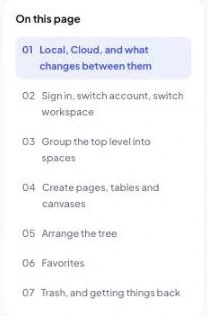
Numbered sections run down the middle. On a wide window On this page sits to the right, highlighting the section you are reading; where a guide has one, a shortcuts card sits under it with a Mac / Win switch that rewrites every key, and remembers your choice.
A screenshot opens at full size in a new tab when you click it. At the bottom, Previous guide and Next guide walk through the manual in order.
- 1.Use On this page to jump to the section you need.
- 2.Set the shortcuts card to Mac or Win once — it stays that way.
- 3.Check the updated date — a guide that predates a release may be behind it.
It is a static site, and that is the point
There is no login here, no workspace data, and no account settings. The site is exported as static HTML, which is why it loads fast and why there is nothing on it to sign in to.
Everything that creates, reads or changes your data happens at app.notekub.dev, behind a sign-in. The two are separate origins on purpose.
- 1.Use Open app for anything involving your own content.
- 2.Expect a sign-in there, and none here.
- 3.A share link someone sends you also opens on the app side, not this one.
Reading it on a phone
The layout is responsive. On a narrow screen the manual's left rail becomes a drawer behind the menu button in the header, and it still lists the sections of the guide you are in — On this page is shown only on a wide window, so the drawer does that job instead.
Screenshots shrink to fit the column; tap one to open it at full size. Wide content — a table, a code block, a diagram — scrolls inside its own box rather than pushing the page sideways, so the page itself never scrolls horizontally.
- 1.Press the menu button to open the guide list and the current guide's sections.
- 2.Tap a screenshot to read it at full size.
- 3.Tap outside the drawer, or its ×, to close it.
Getting to the guides from anywhere
The manual is linked from the header on every page of the site, in both languages, and from the footer.
Each guide has a stable URL of the form /manual/<topic>/ — so a link to one keeps working, and is worth pasting into a thread rather than describing where to click.
- 1.Copy the URL from the address bar to link a specific guide.
- 2.Add /th/ in front to link the Thai version of the same page.
- 3.Link the section too — every heading has its own anchor.